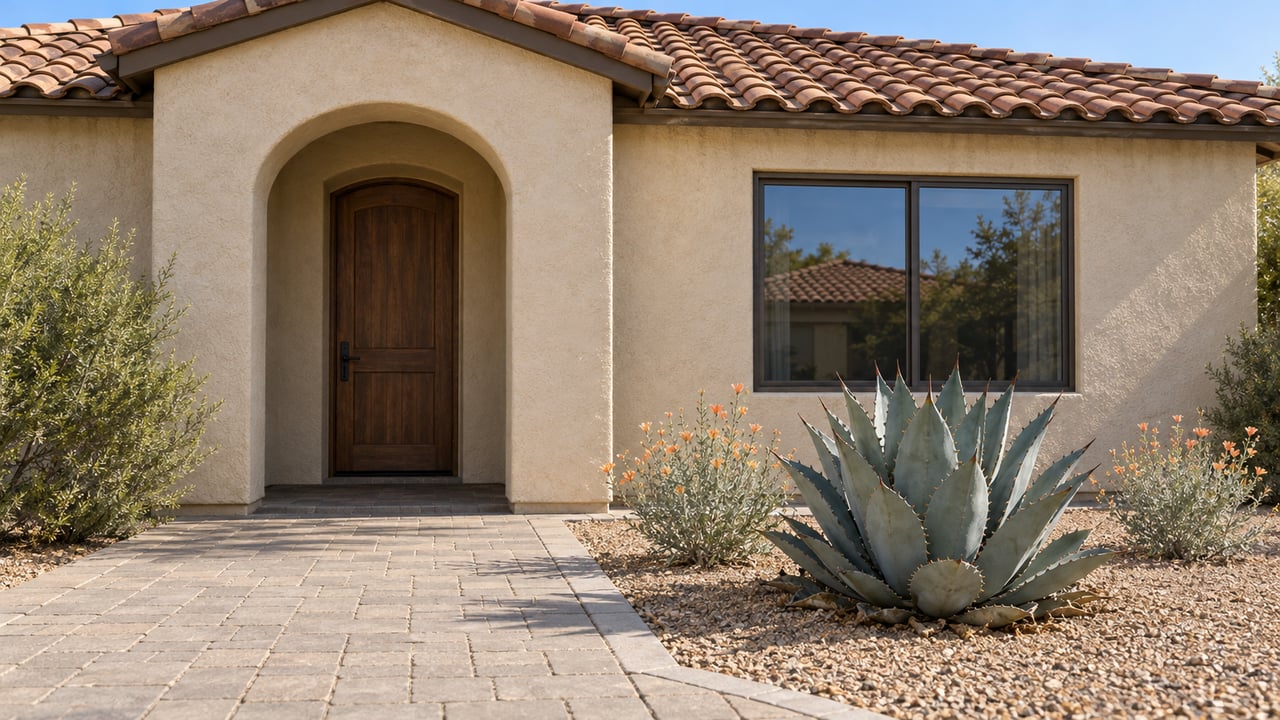
What exactly are you buying when the listing for a Scottsdale vacation rental shows a full booking calendar, five-star reviews, and a city license number in the photo of the door notice?
You get the house and the furniture. The legal permissions that produced that booking history stay with the seller. Scottsdale City Code §18-153(b) says it directly: "No license shall be transferable either as to location or as to person." What can carry over is less obvious. That includes enforcement history tied to the address and the rules in the community's original declaration. Those items deserve more of your diligence than the revenue spreadsheet.
Everything With the Seller's Name on It Restarts
On the day you close, every credential the seller used to operate is either personal to the seller or tied to the seller's ownership. The city license can't be transferred. The Arizona Department of Revenue says a transaction privilege tax license can't be transferred when business ownership changes, and a new license number is required. Stays under 30 days are still taxable short-term lodging under ADOR's rules. That didn't change on January 1, 2025, when city TPT on residential rentals of 30 days or longer ended.
The order matters, because Scottsdale's application asks for a valid TPT number. Here is the sequence a new owner works through, drawn from the city's owner and operator page and state statute:
| Step | Who issues it | What the rule says |
|---|---|---|
| TPT license | Arizona Department of Revenue | New license number required on a change of ownership |
| Scottsdale STR license | City of Scottsdale | $250 per property per year, non-refundable; approval may take up to seven business days |
| Neighbor notification | Owner to adjacent and facing properties | Must include license number, address, and a 24-hour emergency contact |
| Liability insurance | Owner or booking platform | At least $500,000 |
| County rental registration | Maricopa County Assessor | Update within 10 days after a change; fee of up to $10 |
| Posted notice | Owner | 14-point bold, laminated, inside the front door and the main backyard door |
If the home has a pool, hot tub or spa, Scottsdale's pool barrier requirements for short-term rentals also apply.
Neighbor notification follows two clocks. Scottsdale's page says notice is due within 30 days of receiving the license. A.R.S. §9-500.39 ties notice to the moment a rental is first offered. When contact information changes, the city's attestation page asks for written notice within 15 business days, including the new emergency contact's name, address and round-the-clock phone number. If you plan to keep the seller's future bookings, the state timing sets the deadline. The city's 30 days doesn't extend it.
Put the steps together and you have a real gap between the deed recording and the first lawful guest under your name. For a home sold with reservations on the calendar, that gap is a scheduling problem to settle in the contract. Leaving it to the week of closing can be expensive.
What May Stay With the Address
The seller's permissions don't transfer. A property's record is a different matter, and both state and city law treat it differently.
State law describes the violations that can support a suspension as "associated with a property." A court can suspend a property's use as a short-term rental for up to 12 months. Under Scottsdale Code §18-158, suspension proceedings can start after three verified violations within 12 months or after certain serious violations. A final suspension is ordinarily one year, which can be cut to six months in stated circumstances. Section 18-157 bars a person whose license was denied or revoked from reapplying at that same property for one year. A hearing officer can shorten or waive that period when a denial came from a good-faith failure to provide complete information or from unpaid fees that were paid by the time of the hearing.
The city code doesn't say a former owner's violation record automatically becomes the buyer's. It also doesn't promise a clean slate. A court-ordered suspension of a property's use is a separate matter from a license that was never transferable to begin with. That uncertainty is the reason to check the address before the inspection period ends.
The city gives you a way to check. Scottsdale's short-term rental resource center lets anyone look up individual rentals. It shows a status code for each property: P for passing minimum requirements, F for failing, I for an application pending, and E for expired with no pending renewal. City staff run compliance checks every day for registration, insurance and neighbor notification. A listing that shows strong revenue while the address shows F or E is telling you two different things, and the second one matters more.
The Climate a New Owner Walks Into
Scottsdale spent 2026 tightening the rules on how existing permissions get used. It didn't add new caps, which state law doesn't allow. That shift makes a property's history more relevant to a buyer, not less.
On June 23, the City Council adopted Ordinance No. 4719, which defines an "event center" for the first time. Organized gatherings tied to commercial purposes, or that require permits, now count as event-center use, including weddings, receptions and conferences. Normal residential get-togethers don't. City Attorney Luis Santaella said it plainly:
"Short-term rentals are allowed for residential uses. They are not event venues."
That ordinance matters to any buyer whose pro forma includes event bookings. The 12News report notes that state law already barred short-term rentals from operating as commercial venues. The new definition gives the city clearer footing to enforce that ban. Separately, AZFamily reported on July 3, 2026 that a new ordinance gives police more authority to shut down problem-party properties, with owners facing possible loss of their rental license.
The enforcement numbers show how active the city has been. KTAR reported on October 8, 2026 that:
- Scottsdale counts 2,966 active short-term rental licenses.
- In August 2026, the city received 90 new applications, processed 87 renewals, issued 199 licenses and collected $9,000 in penalty fines.
- From January through August 2026, police responded to 665 calls for service at short-term rentals and filed 460 charges, 359 of them for non-compliance.
- Non-compliance charges rose 46% from June through August compared with the prior three months, while total STR calls fell 23% from July to August.
Most of those charges were for non-compliance, not nuisance. That points at the paperwork in the table above, which is exactly what restarts when ownership changes. Police Chief Joe LeDuc said in the same report that "most short-term rentals operate without significant problems," and that the department will act when a property creates repeated concerns.
At the state level, HB 2429 would have extended the violation lookback for license suspension from 12 to 24 months. It passed the House 37-14 on March 16, 2026, as Sedona Red Rock News reported. By May 1 it still hadn't received a Senate committee hearing, according to the Arizona Capitol Times. KTAR reports the city is backing state proposals that include higher licensing fees, clearer definitions and updated rules on property liens. A buyer underwriting a five-year hold is underwriting that legislative direction too.
The Declaration You Inherit Matters More Than the Board You Meet
Inside a homeowners association, Arizona's starting point is A.R.S. §33-1806.01. Rental use is allowed unless the declaration prohibits it, and owners must follow any rental-period limits the declaration sets. Two recent Court of Appeals decisions show how much depends on the original wording.
In Gross v. The Shores, decided October 10, 2024, the court struck down a 30-day minimum added by amendment. The existing CC&Rs had allowed short-term leases and gave owners no foreseeable basis for the new restriction.
In Le v. North Shore, filed June 9, 2026, the court upheld a board-adopted 30-day rule at a community in Tempe. That declaration already barred leasing units "for hotel or transient purposes." The court read "transient" to mean stays under 30 days, consistent with state tax law and Tempe's zoning code. The decision is marked not precedential.
Read together, the two cases show why a seller's operating history doesn't prove anything about future permission. A home could have rented short-term for years under a declaration whose existing language might support a 30-day rule later. The document to read during diligence is the recorded declaration, together with any rules adopted under it. An attorney is the right person to interpret it for a specific community.
A Diligence Order That Follows the Risk
- Look up the address in Scottsdale's resource center and note its status code.
- Ask the seller in writing about any suspension proceedings, court actions, or police charges at the property.
- Pull the recorded declaration and any rental rules, and read them for words like "transient," "hotel," or minimum lease terms.
- Line up your TPT application early, because the city license application needs that number.
- Settle in the contract who handles existing future bookings, given the state rule that notice comes before the first offer.
- Remove any event-based revenue from the projections that Ordinance 4719 now defines as event-center use.
Frequently Asked Questions
Can the seller's Scottsdale license number stay active after closing? No. Section 18-153(b) makes licenses non-transferable as to location or person, and a new owner applies on their own.
Does renting for 30 days or more avoid the city license? Yes. Scottsdale's license applies only to rentals of less than 30 days.
Does the nuisance party ordinance apply only to rentals? No. Scottsdale's ordinance on nuisance parties and unlawful gatherings, SRC 18-121, applies to all private residences, including long-term rentals and owner-occupied homes.
If you're weighing an offer on a Scottsdale home that's run as a vacation rental, The Bray Team can pull the address status, line up the declaration review, and build the license timeline into your contract before you commit. If you're the owner preparing to sell one, request your home valuation, and we'll help you show buyers a clean record from the first showing.
This article is general information, not legal, tax or financial advice. Consult a qualified professional about your situation.